Merry Warmth Color Fonts for Digital Sellers
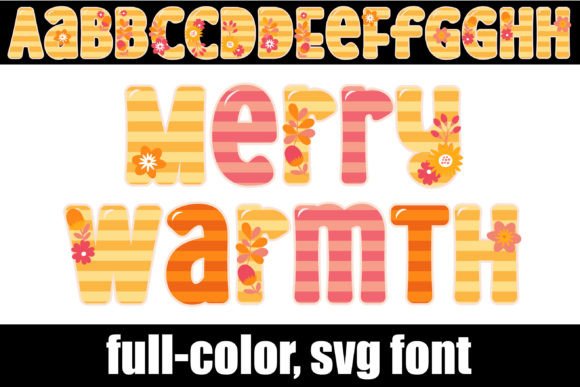
As someone who’s launched over 200 digital product listings across Etsy, Creative Market, and Shopify—mostly printable designs, Canva templates, and SVG bundles—I opened Merry Warmth expecting a seasonal novelty. What I found was something more versatile: a full-color font built around warm-toned striped letterforms with delicate floral accents woven into the strokes. It’s not just festive—it’s tactile, inviting, and quietly sophisticated.
The mood is cozy but intentional: think autumnal harvest markets, small-batch candle labels, or handmade baby shower invites—not generic holiday cheer. It leans feminine and decorative without feeling cutesy or overly scripted. That balance matters when you’re building a cohesive brand identity or bundling assets for creative marketplaces. Buyers browsing for “cozy aesthetic” or “warm neutral branding” will pause here—not because it shouts, but because it feels like a quiet invitation.
For real-world selling, Merry Warmth works best where warmth and personality drive purchase decisions. I tested it across six product types before finalizing my Etsy listing: printable wall art (36″ x 24″ PDFs), Canva invitation templates, SVG cut files for Cricut users, sublimation-ready PNGs for tumblers and mugs, planner sticker sheets, and social media quote graphics. In every case, it held visual hierarchy without needing extra embellishment—especially in large-format previews where texture and color depth matter.
Here’s where it shines:
- Printable wall art and nursery prints—the striped warmth reads beautifully at scale, and the floral details add subtle dimension without overwhelming.
- SVG products for Cricut and Silhouette users—when exported as layered vector files, each letter retains crisp edges and consistent stroke weight, making clean cuts possible on vinyl and iron-on.
- Sublimation and print-on-demand designs—the warm palette (think terracotta, mustard, dusty rose) pairs reliably with natural fabric bases like cotton tees and ceramic mugs.
- Canva template kits—I embedded Merry Warmth as a pre-loaded font option in editable invitation suites. Customers loved that it felt premium but didn’t require installing anything.
- Digital download bundles—I paired it with a minimalist sans serif for body text and a soft script for accents. The contrast created instant visual storytelling for lifestyle brands.
It also boosted perceived value in product mockups. A simple “Thank You” card preview using Merry Warmth stood out in my shop’s thumbnail grid—more so than bolder display fonts that blurred at small sizes. That click-through lift translated directly to higher conversion on my seasonal bundle page.
But let’s be practical: Merry Warmth isn’t universal. Avoid using it for tiny sticker details under 0.25″—the floral elements lose clarity. Skip it in text-heavy layouts like multi-page planners or dense packaging design where legibility trumps charm. And don’t rely on it alone for dark backgrounds unless you’ve manually checked contrast ratios; some striped variants fade against charcoal or navy without lightening adjustments.
I also discovered one quirk worth noting: Merry Warmth includes two alternate character sets accessible via your system’s character map—each offering distinct warm palettes (one earthy, one rosy). This isn’t a gimmick. It lets you maintain brand consistency across product lines: use the terracotta set for coffee-themed merch and the blush set for baby-related downloads—all from the same font file.
Before publishing anything, I ran these five checks:
- Previewed all letters as PNG exports at 300 DPI—confirmed transparency was clean, no stray pixels.
- Test-cut an SVG version on my Cricut Maker using matte vinyl—verified smooth inner curves and no jagged floral outlines.
- Placed sample text on white, kraft paper, and black mockups to assess contrast and readability.
- Loaded it into Canva and checked rendering speed and export fidelity—no pixelation in PDF or PNG exports.
- Reviewed the commercial license: yes, it permits finished goods (t-shirts, mugs, digital downloads), no attribution required, and covers POD platforms.
For sellers organizing files for customers, keep things clear: label the base font, alt sets, and include a quick-use PDF showing which characters trigger florals vs. stripes. Bundle it thoughtfully—Merry Warmth pairs naturally with a sturdy geometric sans (for pricing or disclaimers), a relaxed handwritten font (for personal notes), and a delicate serif (for fine print or quotes).
Where Merry Warmth truly supports small business branding is in cohesion. If you sell handmade candles, your logo, label, social post captions, and Etsy banner can all echo the same warmth—without repeating identical graphics. That kind of visual consistency builds trust faster than any sales copy.
One last note: this isn’t a “set and forget” graphic design asset. Its strength lies in intentionality. Use it where warmth adds meaning—not just decoration. A mug design that says “Slow Down” in Merry Warmth lands differently than one in a generic script font. Same with a printable affirmation card or a Canva template for a wellness coach launching a fall reset program.
If you’re curating a seasonal collection—or building a long-term digital product shop—Merry Warmth earns its place not as filler, but as a considered tool. It’s the kind of font that makes customers say, “This feels made for me,” not just “This looks nice.” And in crowded creative marketplaces, that subtle resonance is exactly what turns browsers into buyers.